Les transformateurs électriques occupent une place essentielle dans la transmission et la distribution de l’énergie. En isolant électriquement les réseaux et en adaptant les niveaux de tension pour répondre aux besoins spécifiques des applications, ils assurent un transfert efficace et sûr de l’énergie électrique. Par ailleurs, la configuration des enroulements, c’est-à-dire la manière dont les bobines du transformateur sont interconnectées entre elles permet de répondre à différents besoins des installations électriques.
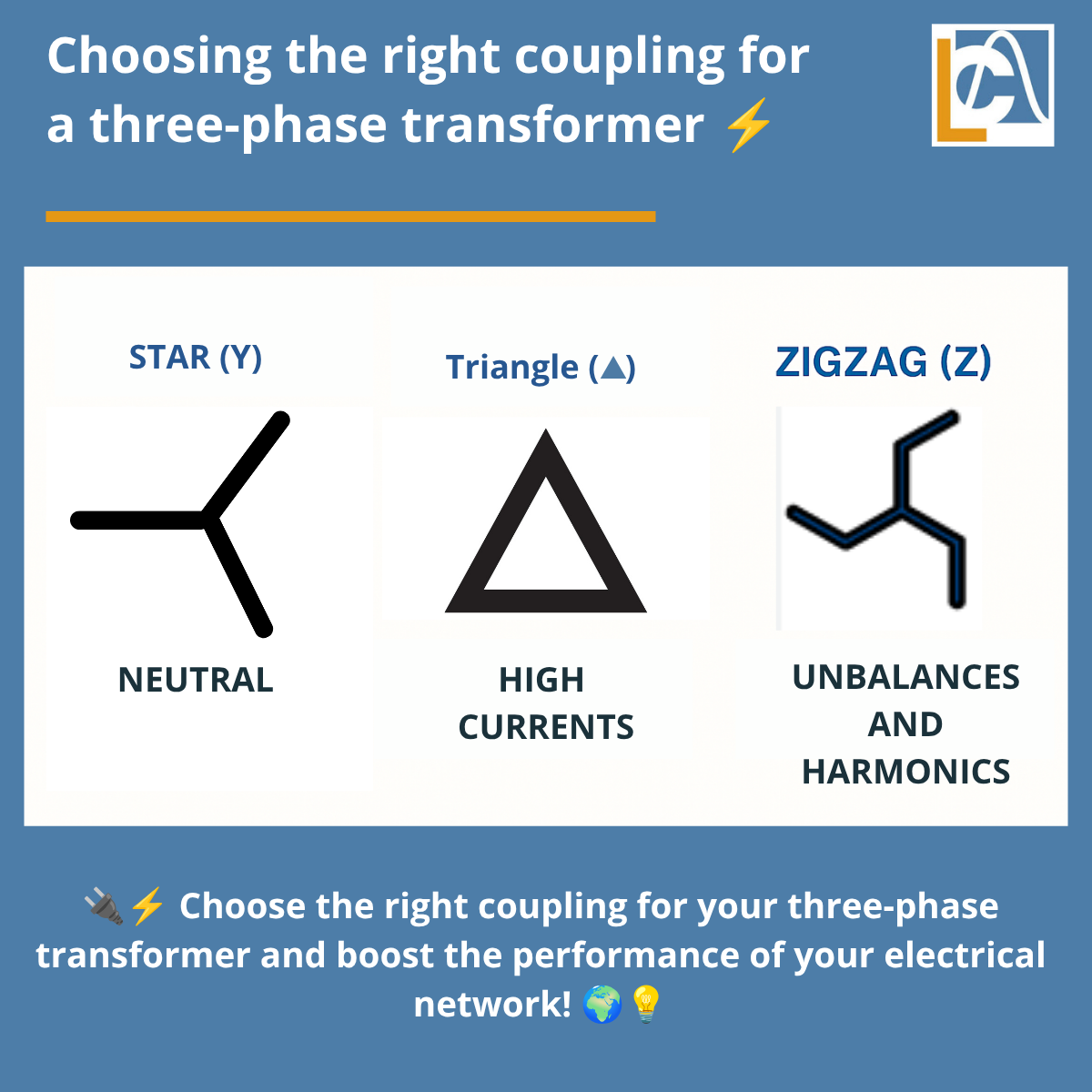
Star coupling (Y)
In this configuration, each winding is connected between a phase and a common point called neutral. This coupling is particularly suitable for high-voltage applications, as it reduces the voltage across the windings by a factor of √3, thus reducing the insulation risks.
But its main interest lies in the presence of the neutral point in secondary schools. In this configuration, the neutral allows the transformer to be grounded, the neutral regime to be changed and to avoid the floating of the power grid with respect to the ground, which could damage the following systems (e.g. sensitive digital controls)
Incidentally, it also allows distribution for single-phase loads between phase and neutral. Be careful in this case to remain vigilant and not to significantly unbalance the transformer.
Triangle coupling (D or Δ)
Here, the windings are connected end-to-end to form a closed circuit, with no neutral point. This configuration is advantageous for low-voltage applications requiring high currents, as it reduces the current flowing through each winding by a factor of √3. However, the absence of neutral does not allow for grounding. This is why this coupling is generally used in the primary of three-phase transformers.
Zigzag Coupling (Z)
Zigzag coupling is a variant of star coupling where each winding is divided into two halves, each connected to different phases. This configuration is used to reduce voltage imbalances and harmonics in distribution networks.
This configuration is not used much and should be avoided as much as possible because transformers are much larger, complicated to manufacture and therefore expensive.
Primary and secondary, which couplings to choose?
In a three-phase transformer it is always preferable to mix the couplings between the primary and the secondary, so you have a partial rebalancing effect of the networks and a limitation of harmonics.
The most commonly used couplings:
DY: Great standard of electrical distribution with neutral sound in the secondary to manage neutral regimes
YD: ratherused for very low voltages in the secondary.
YY: Especially when you don't want phase shiftsbetween primary and secondary (e.g. synchronization of generators, voltage measurements)
With Le Cosinus all couplings are possible, including transformers with several secondary to different couplings.
Vector groups and linkage designation
Three-phase transformers are often characterized by a group of vectors, indicating the phase relationship between the primary and secondary windings. For example, a star-triangle coupling with a phase shift of 30° is denoted Yd11. This notation is essential to ensure compatibility between transformers in a power grid or in three-phase rectifiers for example.
Most commonly used vector group are: Dy11 (330°), Yy0 (O°) Dy5 (150°)
Note that each index indicates the phase shift of the transformer: (e.g. 5= 5x30= 150°)
The important thing to remember is that the choice of coupling depends on the specific requirements of the application, such as the voltage level, the management of load imbalances and the need for a neutral point. A thorough understanding of the different types of coupling helps to achieve the desired result, optimize the performance and reliability of power distribution systems.
Do not hesitate to consult the technicians of the company Le Cosinus to confirm your choices!
Une machine éloignée du tableau électrique, ou qui ne fonctionne pas avec la tension disponible sur le site : dans ces situations, plusieurs solutions existent, et l’autotransformateur en fait partie.…
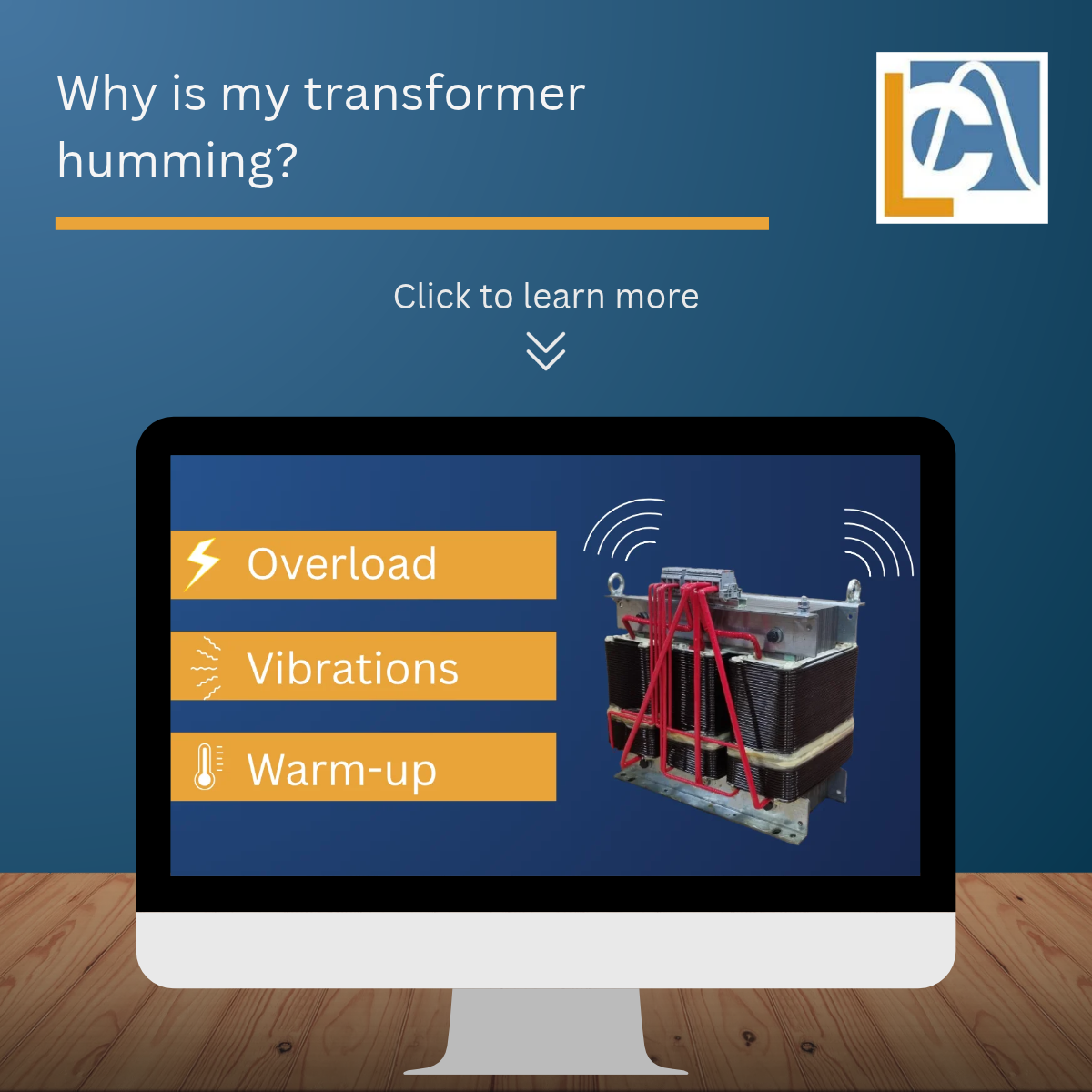
A transformer that hums isn't necessarily defective. An electrical transformer naturally produces a slight hum when it's operating. The laminations in the magnetic circuit expand and contract very slightly…
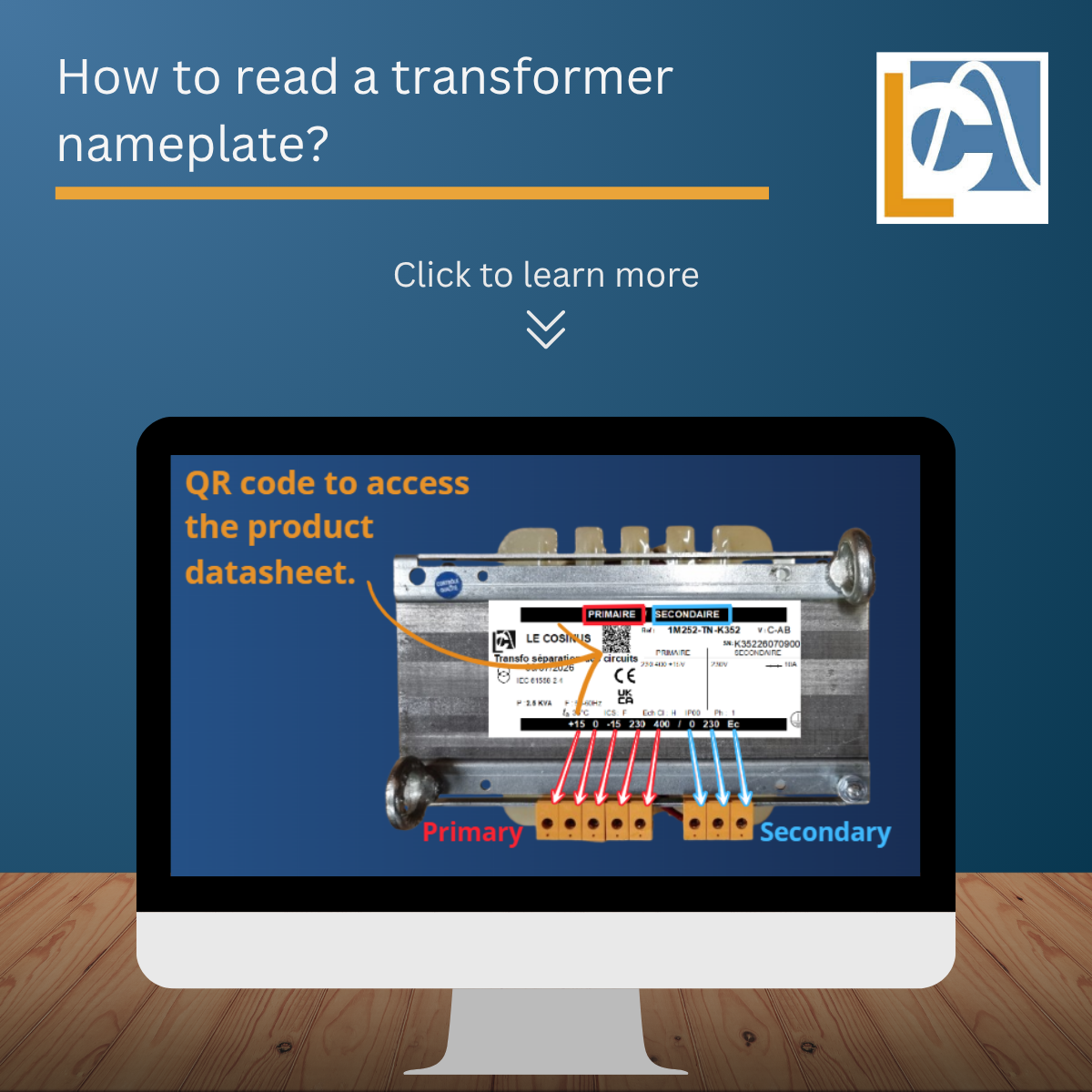
Connecting a transformer is not just about connecting conductors. To ensure a reliable, high-performance and safe installation, it is essential to know how to correctly interpret the nameplate.…