Lors de la conception d’une installation électrique, le choix du transformateur est une étape clé. Une estimation précise de la puissance nécessaire permet d’assurer un fonctionnement optimal tout en évitant les surcharges et les pertes énergétiques. Voici les étapes essentielles pour calculer la puissance requise d’un transformateur.
1. Determine the apparent power (S)
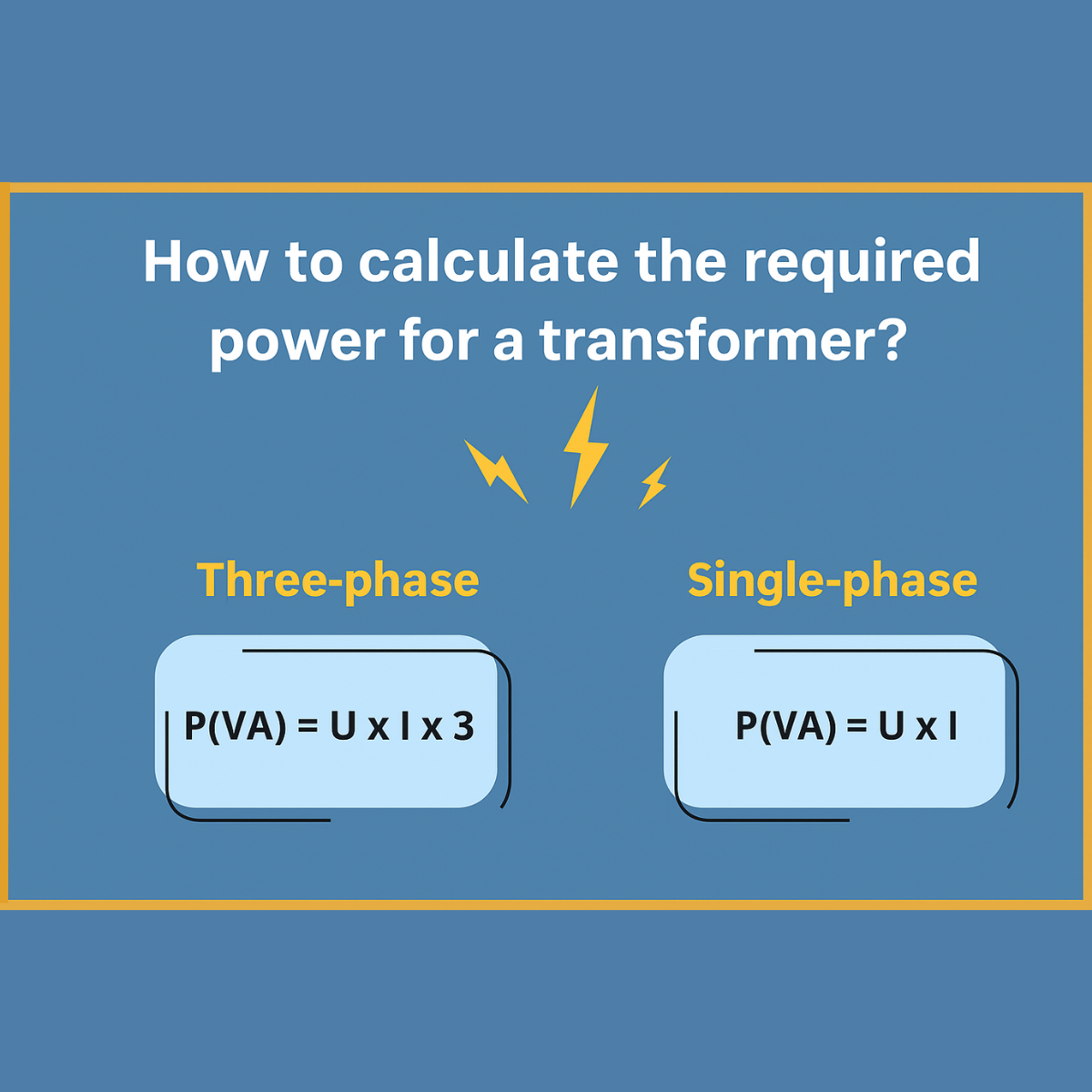
The power of a transformer is expressed in kilovolt-amperes (kVA). To calculate it, the following formula is used:
S (VA) = U (V) × I (A) x √3
Where:
U is the input or output voltage (in volts),
I is the nominal current (in amperes).
2. Consider the power factor (cos φ)
In an electrical network, the actual power (P) and the apparent power (S) are related by the power factor:
P (kW) = S (VA) × cos φ
The power factor depends on the nature of the loads being fed (resistive, inductive or capacitive). For inductive loads (motors, transformers, etc.), it is usually between 0.8 and 0.95.
3. Consider Connected Loads
It is essential to add up all the planned loads on the grid to determine the total power required. A safety margin must also be provided to avoid overloading and allow for possible extensions.
4. Predict energy losses
Transformers generate losses in the form of heat. These losses are generally of two types:
Iron losses :due to the magnetic core of the transformer.
Copper losses: due to the resistance of the windings.
A high transformer efficiency (over 95%) helps to limit these losses.
5. Examples of Calculation
Example: A single-phase industrial motor operates under 400 V with a current rating of 50 A and a power factor of about 0.8 (Cos Phi 0.8).
Single-phase motor power is: P = 400*50 = 20 kW
The apparent power seen by the transformer will be: S= 20 kW / 0.8 = 25 kVA
The transformer will therefore have to have a power of 25kVA
Conclusion
Calculating the power of a transformer is an essential step in ensuring the performance and reliability of an electrical installation. By taking into account the apparent power, power factor, connected loads and energy losses, it is possible to determine the optimal capacity of the transformer adapted to the specific needs of the installation.
Need support in choosing your transformer? The Cosinus offers you solutions adapted to your needs. Contact us now!
Une machine éloignée du tableau électrique, ou qui ne fonctionne pas avec la tension disponible sur le site : dans ces situations, plusieurs solutions existent, et l’autotransformateur en fait partie.…
A transformer that hums isn't necessarily defective. An electrical transformer naturally produces a slight hum when it's operating. The laminations in the magnetic circuit expand and contract very slightly…
Connecting a transformer is not just about connecting conductors. To ensure a reliable, high-performance and safe installation, it is essential to know how to correctly interpret the nameplate.…