The Impact of Phase-Angle and Burst-Firing Power Controllers on Transformer Sizing
In many industrial applications, power regulation has become essential for accurately controlling thermal processes, heating elements, and various types of production equipment.
Among the most widely used solutions are thyristor power controllers, which provide precise and efficient power regulation.
However, one important aspect is often overlooked: the chosen control method has a direct impact on the behaviour and sizing of the transformer installed downstream.
At Le Cosinus, we regularly assist our customers in addressing these challenges. An electrical transformer that is not properly matched to its electrical environment can quickly become a source of overheating, excessive vibration, increased energy losses, or even premature failure.
Understanding the effects of different power control technologies makes it possible to design transformers that are more reliable, more durable, and better suited to real operating conditions.
Phase-Angle Power Control: The Challenge of Harmonics
Operating Principle and Applications
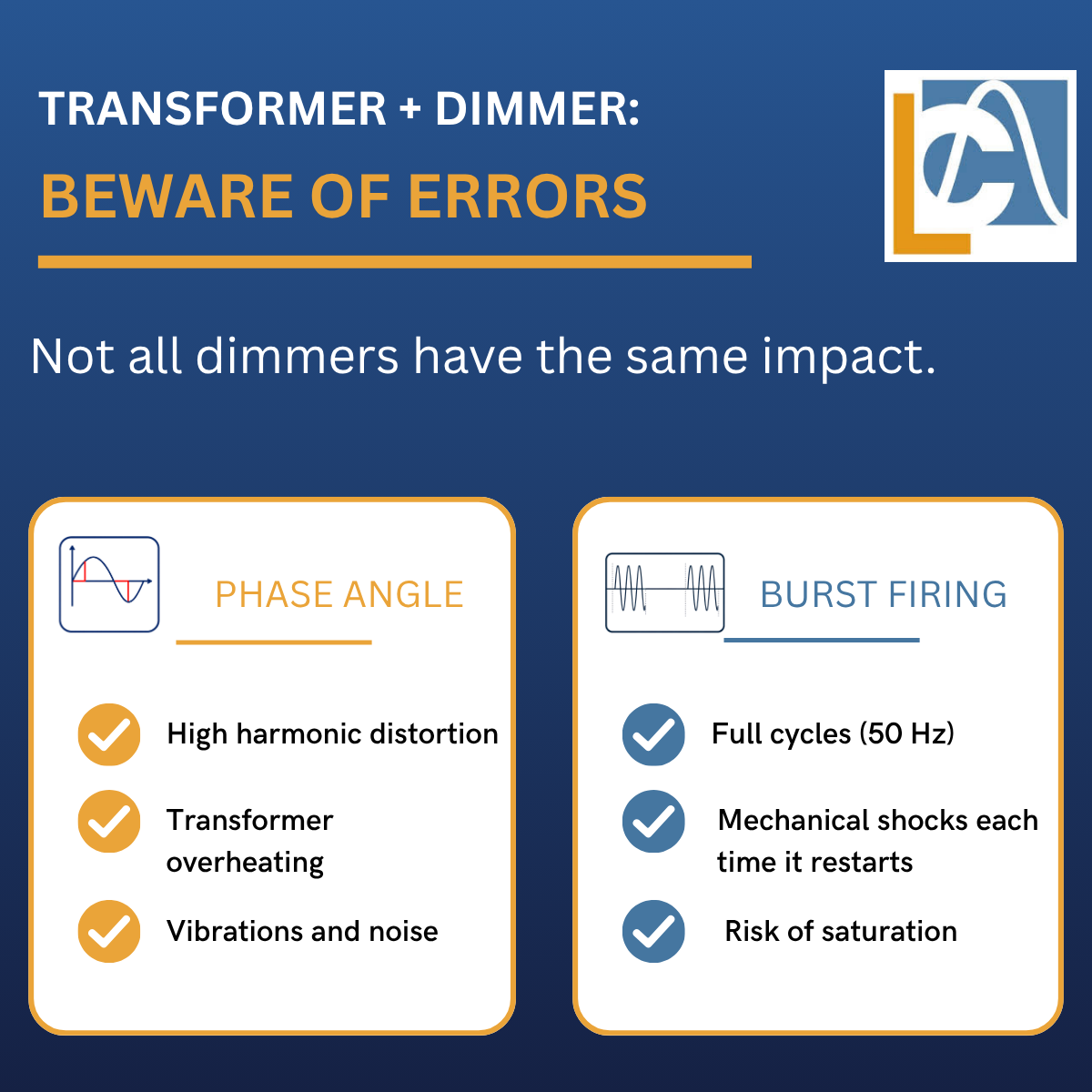
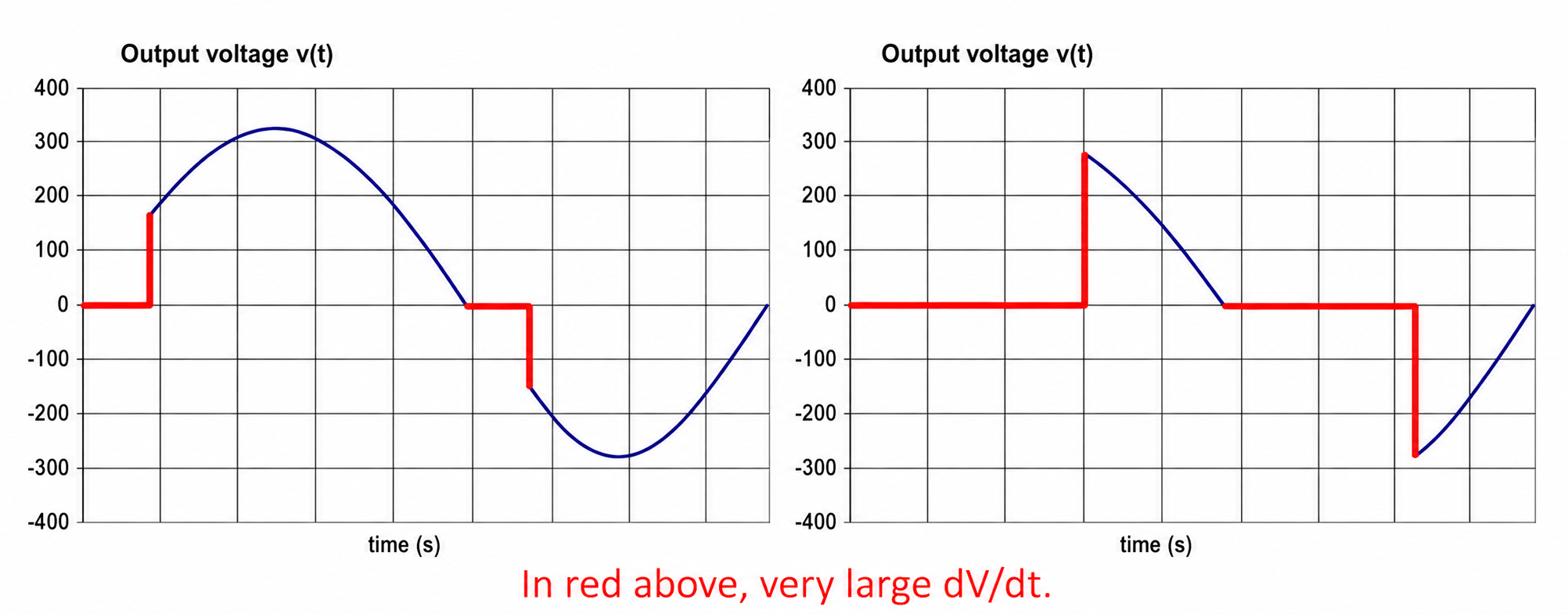
Le gradateur à angle de phase fonctionne en « découpant » la sinusoïde à chaque demi-période. Cette technologie permet une régulation très précise de la puissance, mais elle génère également une forte distorsion harmonique.
This control method remains essential for applications requiring continuous power delivery or very low thermal inertia, including:
Industrial lighting and infrared lamps: It provides a stable light output while preventing flickering and stroboscopic effects.
Inductive loads and transformers: When combined with a soft-start function, it limits the high inrush currents associated with transformer magnetisation.
Effects on the Transformer
The rapid switching of the thyristor generates very high voltage rise rates (dV/dt). For the transformer, this results in several important consequences:
Increased core losses: Rapid variations in magnetic flux generate higher eddy current losses within the transformer core.
Higher copper (I²R) losses: High-order harmonics increase the skin effect in the conductors, raising their effective AC resistance and, consequently, the associated copper losses.
Mechanical vibration and acoustic noise: Flux discontinuities place greater mechanical stress on the laminated magnetic core, resulting in increased vibration and audible noise.
Greater insulation stress: The transformer windings are subjected to higher electrical stress between adjacent turns, which can accelerate insulation ageing.
Our Approach at Le Cosinus
To minimise these effects, we adapt the transformer's design from the very beginning of the project by:
Optimising the magnetic flux density to prevent core saturation.
Using high-performance grain-oriented electrical steel laminations whenever required.
Taking the K-factor into account to correctly size the transformer's apparent power based on harmonic distortion and the increased conductor losses caused by the skin effect.
Burst-Firing Power Control: Thermal and Mechanical Challenges
Operating Principle and Applications
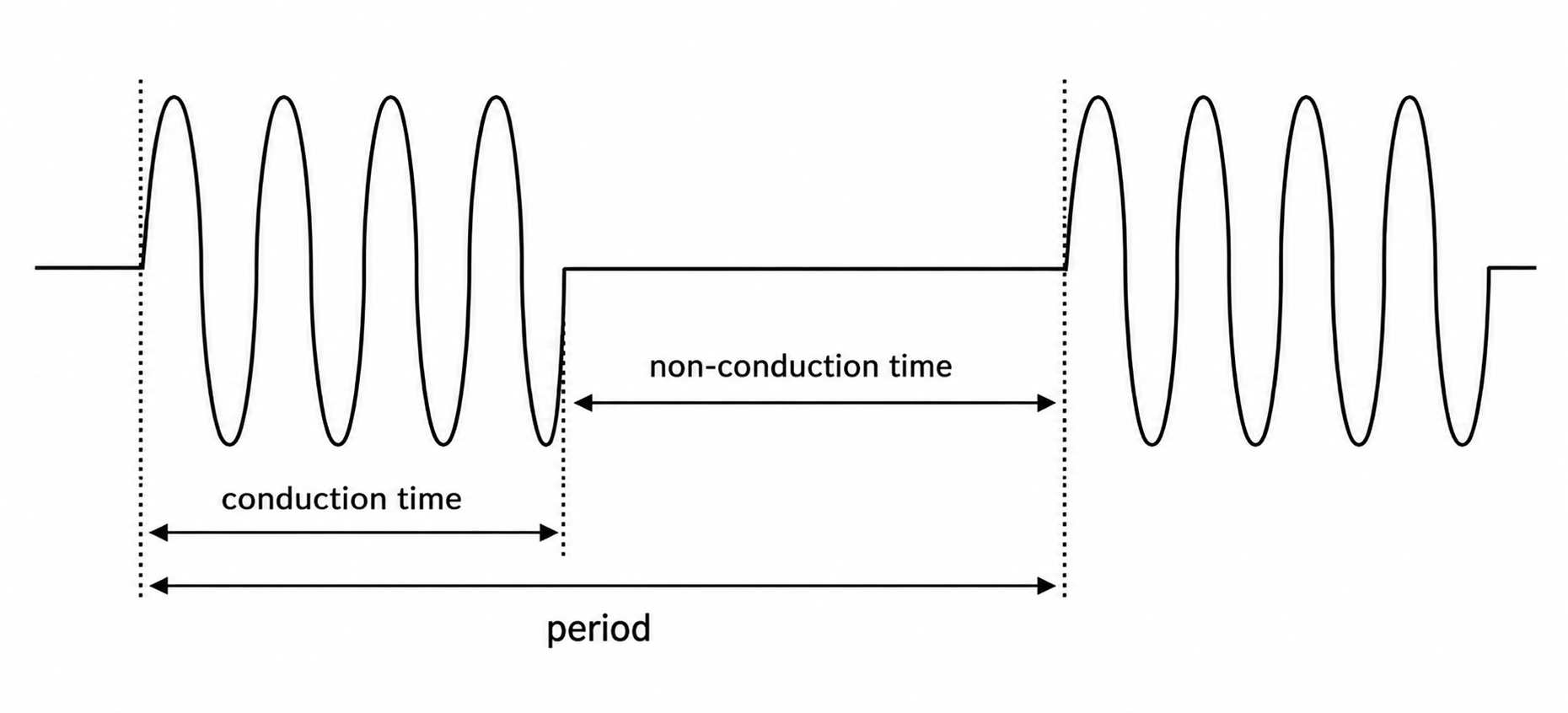
A burst-firing power controller operates differently. It allows complete AC cycles to pass before temporarily interrupting the supply.
Unlike high-frequency switching systems, it operates solely at the mains frequency (50 Hz in most European countries).
Because switching occurs at the zero-crossing point of the AC waveform, this technology offers excellent electromagnetic compatibility (EMC), generating very little electromagnetic interference (EMI).
This control method is particularly well suited to loads with high thermal inertia, such as:
Industrial furnaces and electric heating elements: Their thermal inertia naturally smooths the on/off power cycles, resulting in minimal temperature fluctuations.
However, burst-firing control is not recommended—and may even be unsuitable—for certain applications, including:
Electric motors: Repeated start/stop cycles generate mechanical shocks, vibration, and increased mechanical stress.
Lighting systems: The intermittent power supply can produce noticeable and uncomfortable stroboscopic effects.
Effects on the Transformer
The use of burst firing control on the primary side of a transformer requires specific precautions.
If the power controller does not properly manage switching synchronisation or residual magnetic flux, a significant inrush current can occur each time a new burst starts, potentially causing saturation of the magnetic core.
The transformer is also subjected to:
Repeated thermal cycles: Alternating between full load operation and idle periods places mechanical stress on the windings and accelerates insulation ageing.
Significant mechanical forces: Current peaks generate repeated electrodynamic forces within the internal transformer structure.
Our Design Approach at Le Cosinus
For this type of application, we focus on a robust design, both from a magnetic and mechanical perspective:
Reinforced winding support and improved tightening of the magnetic core assembly.
Larger core cross-sections to ensure operation well away from the saturation zone and limit overcurrents during cycle restarts.
Comparative Summary for Your Applications
Feature
Phase Angle
Wave Train
Applications types
Lighting, IR Lamps, Inductive Loads
Industrial Ovens, Pure Heating Elements
Major constraint
High Harmonics & Iron Losses
Mechanical Shocks & Risk of Saturation
Signal frequency
Chopped (harmonic generator)
Pure 50 Hz (time-sequenced)
THD Current
Very high
Low (Excellent EMC)
Adaptation: Le Cosinus
Reduced Induction & Application of the K-Factor
Reinforced Steel Section & Mechanical Locking
Le Cosinus expertise
For nearly 80 years, Le Cosinus has been designing transformers for demanding industrial environments.
When a transformer is used in combination with a power controller, simply "adding extra margin" is not enough. Proper sizing must take into account:
The actual current waveform;
Thermal constraints;
Mechanical stresses;
Harmonic phenomena generated by the control system.
Our engineering department supports each project to precisely adapt:
Transformer geometry;
Magnetic materials;
Insulation systems;
Cooling solutions.
Do you have a project involving a thyristor power controller?
Feel free to provide us with your installation's technical specifications so that we can deliver a transformer design truly tailored to your application.
Une machine éloignée du tableau électrique, ou qui ne fonctionne pas avec la tension disponible sur le site : dans ces situations, plusieurs solutions existent, et l’autotransformateur en fait partie.…
A transformer that hums isn't necessarily defective. An electrical transformer naturally produces a slight hum when it's operating. The laminations in the magnetic circuit expand and contract very slightly…
Connecting a transformer is not just about connecting conductors. To ensure a reliable, high-performance and safe installation, it is essential to know how to correctly interpret the nameplate.…