Transformers and Autotransformers: Understanding the Differences and Applications
Transformers are indispensable equipment in power grids and industrial systems. Among them, two main categories stand out: conventional transformers and autotransformers. Each has unique characteristics that make them suitable for differentiated uses.
Classic Transformers: Versatility and Isolation
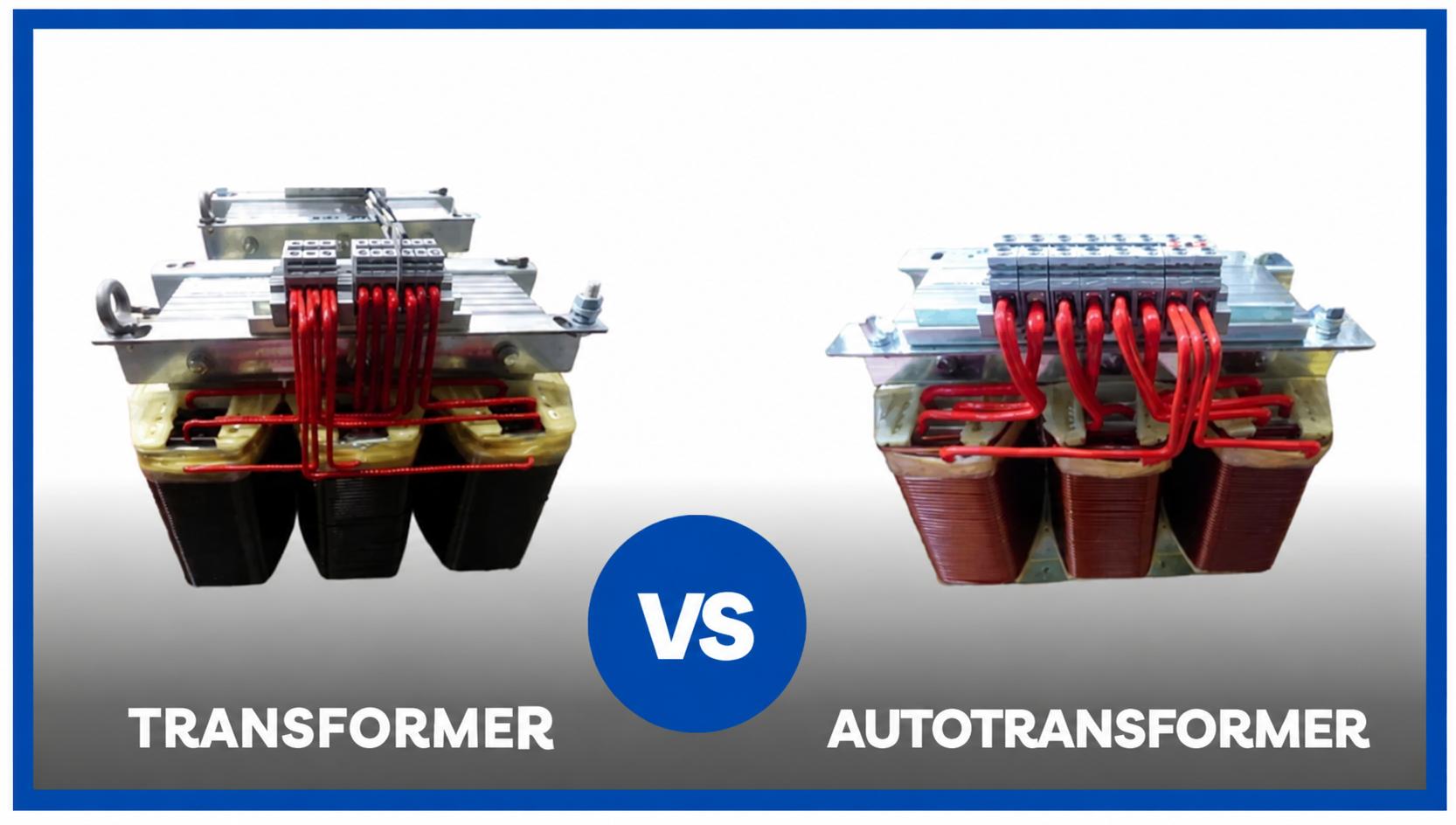
A conventional transformer consists of two separate windings: the primary and the secondary. These windings are electrically isolated from each other, ensuring galvanic isolation between the two circuits. This feature offers several advantages, including increased protection thanks to the insulation that prevents direct current transfers between circuits and thus protects the connected equipment. They also allow for the adaptation of voltages between circuits at very different levels.
However, this design involves a higher volume and cost, especially for high-power applications. This is due to the presence of two completely separate windings, requiring more materials.
Autotransformers: Compactness and Efficiency
Unlike conventional transformers, autotransformers have only one winding, part of which is common to the primary and secondary circuits. This design brings several notable advantages. It reduces costs through the use of a single winding, which decreases the amount of conductive materials required. In addition, autotransformers are more compact and lightweight, making them easier to integrate into smaller spaces. They also offer increased energy efficiency through an optimized design.
However, autotransformers do not provide galvanic isolation between the primary and secondary circuits. This can cause security concerns in some sensitive applications. This makes them more suitable for low transformation ratios, where this lack of insulation is less critical.
Applications and Choice Between the Two Types
Le choix entre un transformateur classique et un autotransformateur dépend principalement des besoins spécifiques de l’application. Les transformateurs classiques sont idéaux pour des applications nécessitant une isolation stricte ou des rapports de transformation élevés. Par exemple, ils sont couramment utilisés dans les réseaux de distribution électrique ou pour alimenter des équipements électroniques sensibles. Les autotransformateurs, quant à eux, sont largement employés dans les applications à faibles rapports de transformation, telles que l’adaptation de tensions nominales ou la régulation électrique dans les systèmes triphasés.
The Normative Definition of the Autotransformer
According to the International Electrotechnical Commission (IEC), an autotransformer is a transformer in which two or more windings have a common part. This definition highlights the particularity of this type of transformer, which stands out for its unique design and specificity of use.
Focus on the Three-Phase Autotransformer
The three-phase autotransformer follows the same principle. It has only one winding per phase, with a secondary being part of the primary winding. This design is particularly suitable for precisely adjusting nominal voltage values in industrial and energy systems.
Conclusion
In summary, conventional transformers and autotransformers are complementary tools, each offering specific advantages. The choice of transformer type should be guided by the technical requirements and safety constraints of each project. At Le Cosinus, we specialize in the design and manufacture of tailor-made solutions to meet the most demanding needs of our customers.