








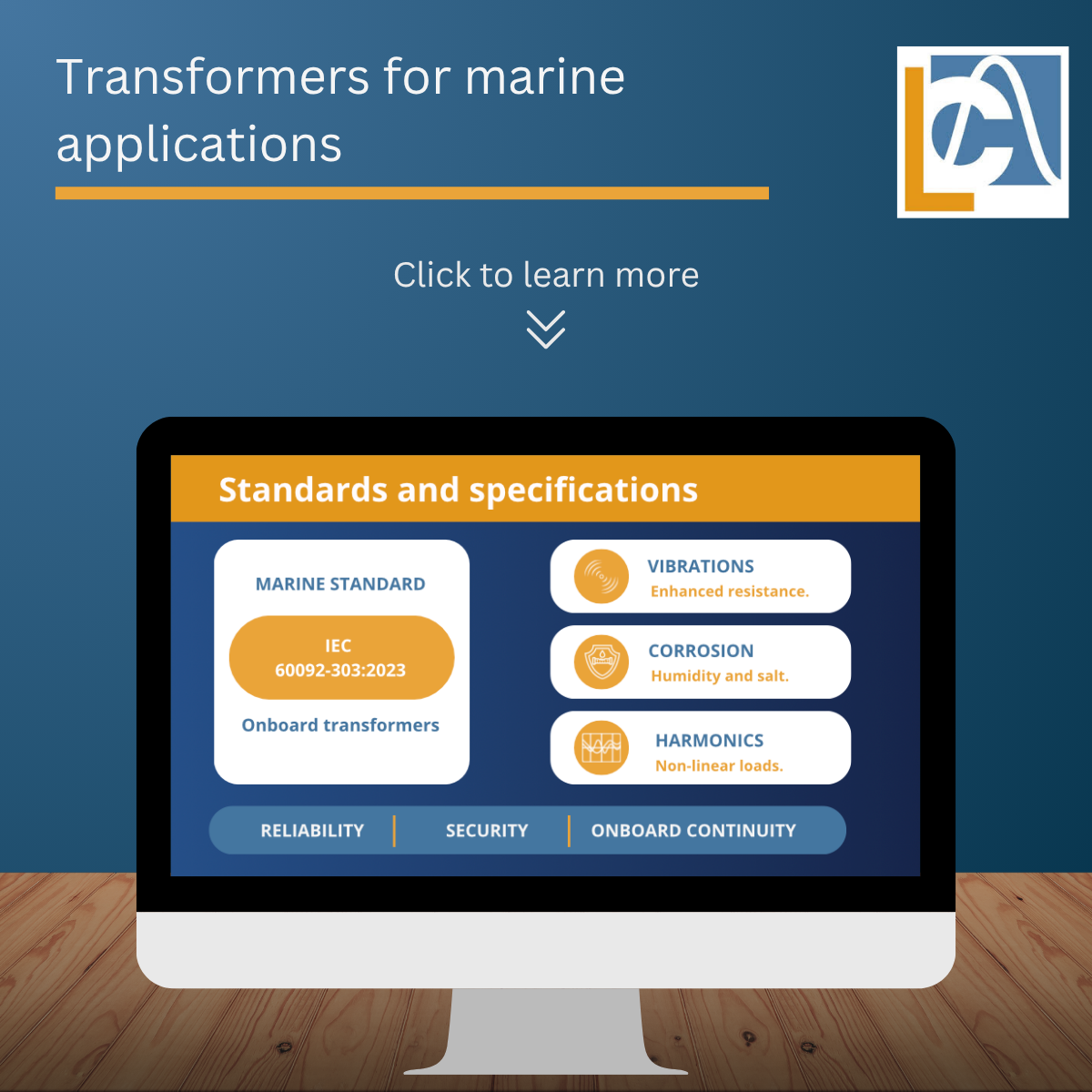
Transformers for Marine Applications: Standards and Specific Requirements
To ensure safe and efficient operation, marine transformers must meet strict regulatory standards. Marine transformers must withstand conditions…
Contact Us
 English (UK)
There is no single mandatory efficiency standard that applies to all transformers. In the European Union, the requirements depend on power rating, voltage, technology, and intended use. Depending on the category, manufacturers must either report losses or comply with maximum loss limits and a minimum energy efficiency level.
The applicable requirements are set forth in Regulation (EU) No. 548/2014, as amended by Regulation (EU) 2019/11783. This regulation is often referred to as the Ecodesign Regulation for transformers. It primarily applies to transformers with a capacity of at least 1 kVA used in 50-Hz power grids or in industrial applications.
Certain transformers designed for measurement, welding, or specific applications may be subject to exclusions. The list of such transformers and the applicable conditions must be verified in the official text. The European Commission states that the current regulation remains in effect following its review.
These requirements are not expressed as a single efficiency rating. Compliance is based primarily on no-load losses, denoted as P0, and load losses, denoted as Pk. No-load losses occur as soon as power is supplied to the transformer, even if no load is connected. Load losses increase with the current delivered. For certain categories, the regulation also uses the peak efficiency index, or PEI.
A rated output specified without indicating the levels of P0 and Pk losses therefore does not allow for a comparison between two transformers. It is necessary to examine the regulatory data corresponding to their category and compare them with the actual operating conditions of the installation.
Under the regulation, this category covers transformers whose highest voltage does not exceed 1.1 kV. It includes many low-voltage transformers. The currently applicable text does not set a general loss limit for them. However, it requires that no-load losses and load losses be reported in the required technical information. The absence of a maximum threshold therefore does not mean there is no obligation.
For medium-power transformers and certain high-power configurations, the appendices specify maximum losses or a minimum PEI. Level 2 requirements, also known as Tier 2, have been in effect since July 1, 2021. The values vary depending on the rated power, voltage, whether the transformer is dry-type or oil-immersed, and certain specific configurations. It would therefore be misleading to cite a single figure for all transformers.
Before a transformer is placed on the market or put into service, the manufacturer, its authorized representative, or the importer—depending on their role—must determine its category and verify any exclusions. The manufacturer then demonstrates the transformer’s compliance based on the required calculations and tests, retains the technical documentation, and provides the required information on losses and performance.
The procedure includes conformity assessment, the corresponding declaration, and CE marking in accordance with the applicable framework. The values must be traceable: the term “high efficiency” does not replace the technical data needed to verify them.
The buyer must first specify the power rating, primary and secondary voltages, frequency, load conditions, and installation requirements. The buyer may then request the no-load and loaded losses, the PEI (where applicable), and the compliance documents. Our article on Ecodesign Directive for transformers explains in more detail the difference between low, medium, and high power.
A major renovation requires the same level of vigilance. For a medium- or high-power transformer, the total or partial replacement of the core, combined with the replacement of at least one complete winding, requires a new assessment of the transformer’s compliance. A repair should therefore not automatically be considered a simple maintenance operation.
Le Cosinus designs standard and custom transformers. The design process takes into account voltage, power, load, temperature, harmonics, and applicable loss requirements. This data allows for a concrete comparison of the transformers under consideration.
To verify the technical scope of your project and define the expected performance, submit your requirements to Le Cosinus. For a contractual agreement or a specific regulatory issue, requirements must be confirmed based on the specifications and the version of the text applicable at the time of the project.
To ensure safe and efficient operation, marine transformers must meet strict regulatory standards. Marine transformers must withstand conditions…
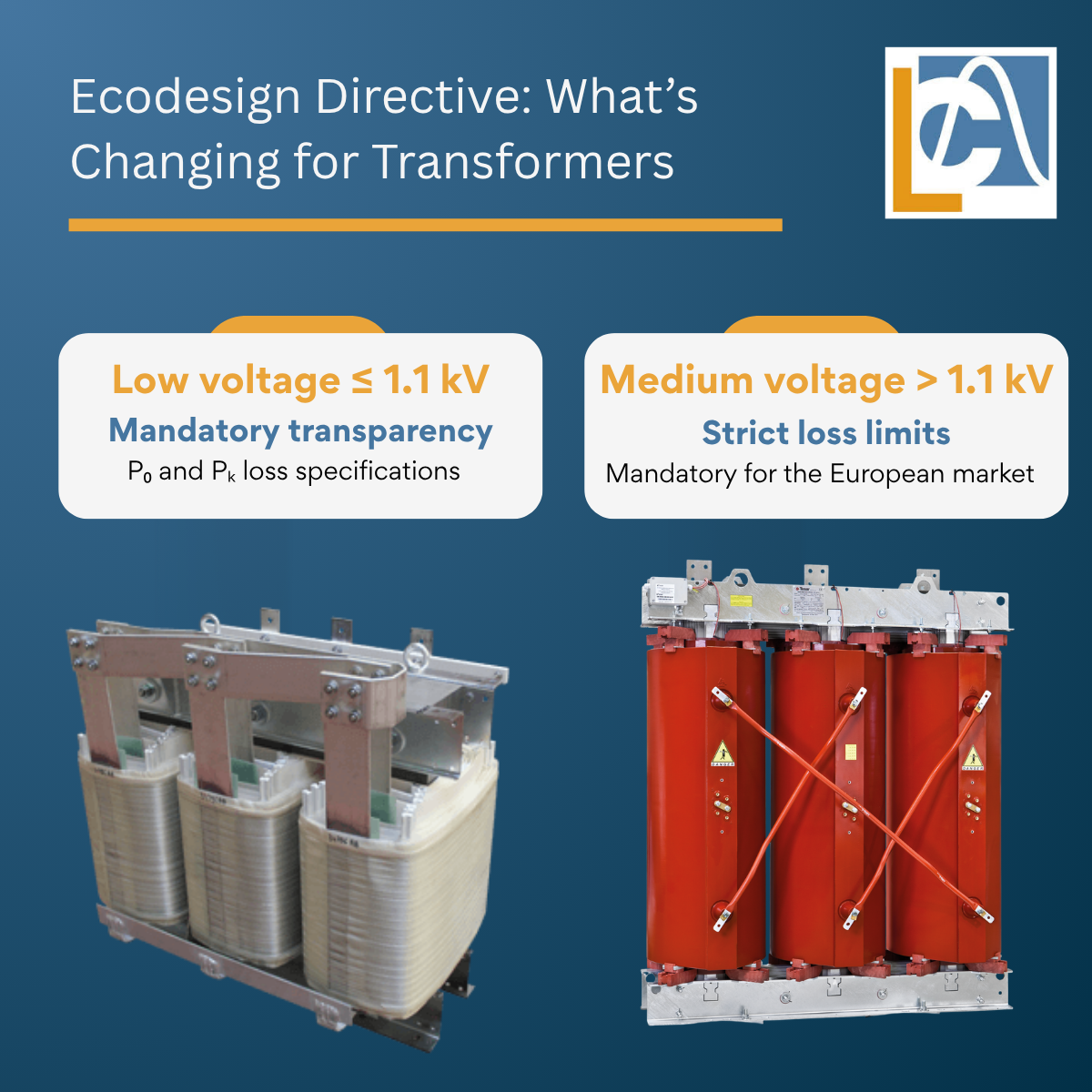
Since 1 July 2021, a major milestone was reached for transformer manufacturers and users in Europe with the entry into force of Phase 2 (or "…
Industrial electrical transformers are subject to a set of standards and regulations designed to ensure their safety, performance and compliance with European and environmental requirements. At Le…
