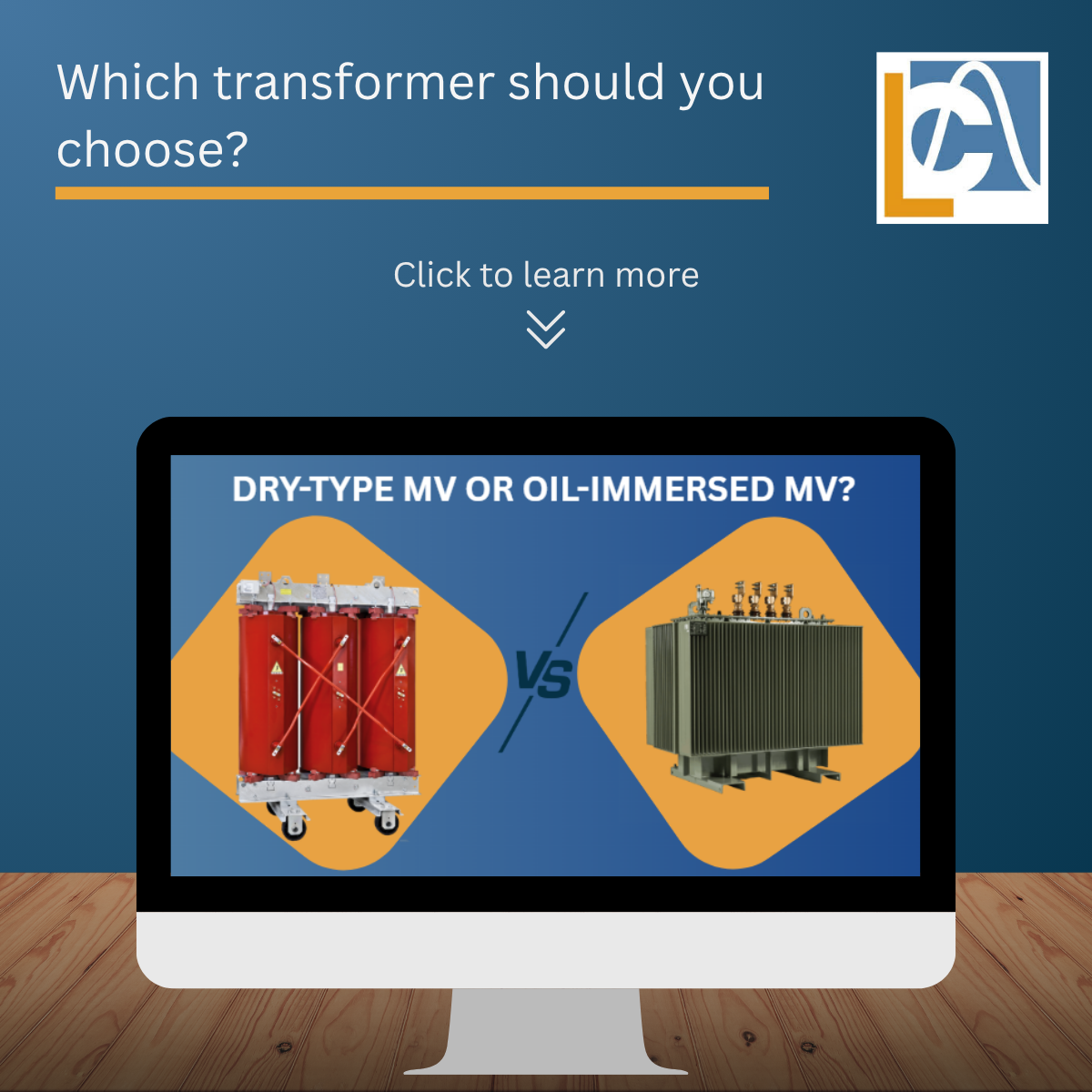
When selecting equipment for a medium-voltage substation, choosing a transformer is not simply a matter of power rating.
The installation environment, safety requirements, maintenance constraints, and operating costs all directly influence which technology is the most suitable.
The two most common solutions are cast resin dry-type transformers and liquid-immersed transformers, commonly referred to as oil-filled transformers.
Each technology offers specific advantages and is suited to different applications and operational requirements.
Cast Resin Dry-Type Transformer: A Solution Well Suited for Indoor Installations
A dry-type transformer uses ambient air for cooling, and its windings are protected by an epoxy resin insulation system. This design provides several advantages, particularly when the transformer is installed inside a building.
Its main advantage is the absence of any dielectric liquid. As a result, there is no risk of oil leakage, which significantly reduces fire safety constraints and environmental protection requirements.
This feature makes dry-type transformers suitable for installation in technical rooms integrated into buildings, public buildings (ERP – establishments open to the public), high-rise buildings, as well as commercial and healthcare facilities.The transformer substation can therefore be located closer to the loads, reducing the length of low-voltage cables and limiting the associated energy losses.
Another key advantage is the relatively simple maintenance required. Apart from periodic cleaning and connection checks, maintenance operations are generally limited.
Precautions That Should Not Be Overlooked
Although dry-type transformers offer many advantages, they also require certain installation precautions.
The first consideration is the ventilation of the transformer room. All energy dissipated by the transformer must be evacuated through the surrounding air. Poor air circulation can quickly lead to an increase in temperature and trigger thermal protection devices.
The installation environment must also be carefully controlled. Although modern resin insulation systems provide excellent performance, factors such as constant humidity, water ingress, or conductive dust remain issues that must be monitored.
Finally, for an equivalent power rating, a dry-type transformer is generally larger than an oil-filled transformer, which may have an impact on the layout and space requirements of the electrical room.
Oil-Filled Transformer: The Preferred Solution for Demanding Environments
An oil-filled transformer uses a dielectric liquid to provide both electrical insulation and cooling for the windings.
This technology is historically the most widely used solution in power distribution networks and high-power industrial installations. Its robustness makes it particularly suitable for outdoor applications and demanding environments.
Unlike dry-type transformers, oil-filled transformers perform very well in humid conditions, polluted atmospheres, and saline environments. This is why they are commonly found in outdoor substations, heavy industrial facilities, photovoltaic plants, and energy infrastructure.
The dielectric liquid also provides excellent cooling performance. Its thermal inertia allows the transformer to better withstand temporary overloads and helps limit temperature rise within the windings.
From an economic perspective, oil-filled transformers are often more cost-effective for high-power applications, particularly above several megavolt-amperes (MVA).
A More Stringent Regulatory Framework
The performance advantages of oil-filled transformers are nevertheless accompanied by more demanding installation requirements.
The presence of a dielectric liquid generally requires the installation of a retention basin designed to collect the fluid in the event of a leak or accidental tank failure.
When mineral oil is used, fire safety considerations must also be taken into account. Depending on the site configuration, this may require specific safety clearances or additional protection systems.
Finally, the higher weight of the equipment must be considered during the infrastructure design phase, particularly when sizing foundations and planning handling and installation operations.
There is no universal answer. The choice primarily depends on the installation context.
A dry-type transformer is often preferred when fire safety, integration within a building, or ease of maintenance are key priorities.
Conversely, an oil-filled transformer is frequently the preferred solution for outdoor installations, harsh environments, or applications requiring high power ratings.
Beyond the transformer's technical specifications alone, the entire project must be considered, including the substation location, regulatory requirements, operating environment, installation costs, and maintenance strategy.
Comparative Summary for the Installer
Installation Criteria
Cast Resin Dry-Type Transformer
Oil-Filled Transformer
Ideal Location
Indoor installations, public buildings (ERP), high-rise buildings (IGH)
Outdoor installations, heavy industry, power distribution networks
Civil Engineering Requirements
Simple installation (standard foundation slab)
More complex requirements (retention basin + surge protection required)
Medium-Voltage Connection
Direct connection to terminals or via separable connectors
Often via plug-in bushings or busbar connections
On-Site Maintenance
Dust removal and connection tightening checks
Oil analysis, leak monitoring, and pressure control
Sensitivity to Overvoltages
More sensitive (requires carefully selected and installed surge protection)
Une machine éloignée du tableau électrique, ou qui ne fonctionne pas avec la tension disponible sur le site : dans ces situations, plusieurs solutions existent, et l’autotransformateur en fait partie.…
A transformer that hums isn't necessarily defective. An electrical transformer naturally produces a slight hum when it's operating. The laminations in the magnetic circuit expand and contract very slightly…
Connecting a transformer is not just about connecting conductors. To ensure a reliable, high-performance and safe installation, it is essential to know how to correctly interpret the nameplate.…