Connecting a transformer is not simply a matter of wiring conductors. To ensure a reliable, efficient, and safe installation, it is essential to correctly interpret the information provided on the nameplate.
The nameplate contains key information such as available voltages, adjustment taps, power rating, operating frequency, recommended protections, and the wiring diagram.
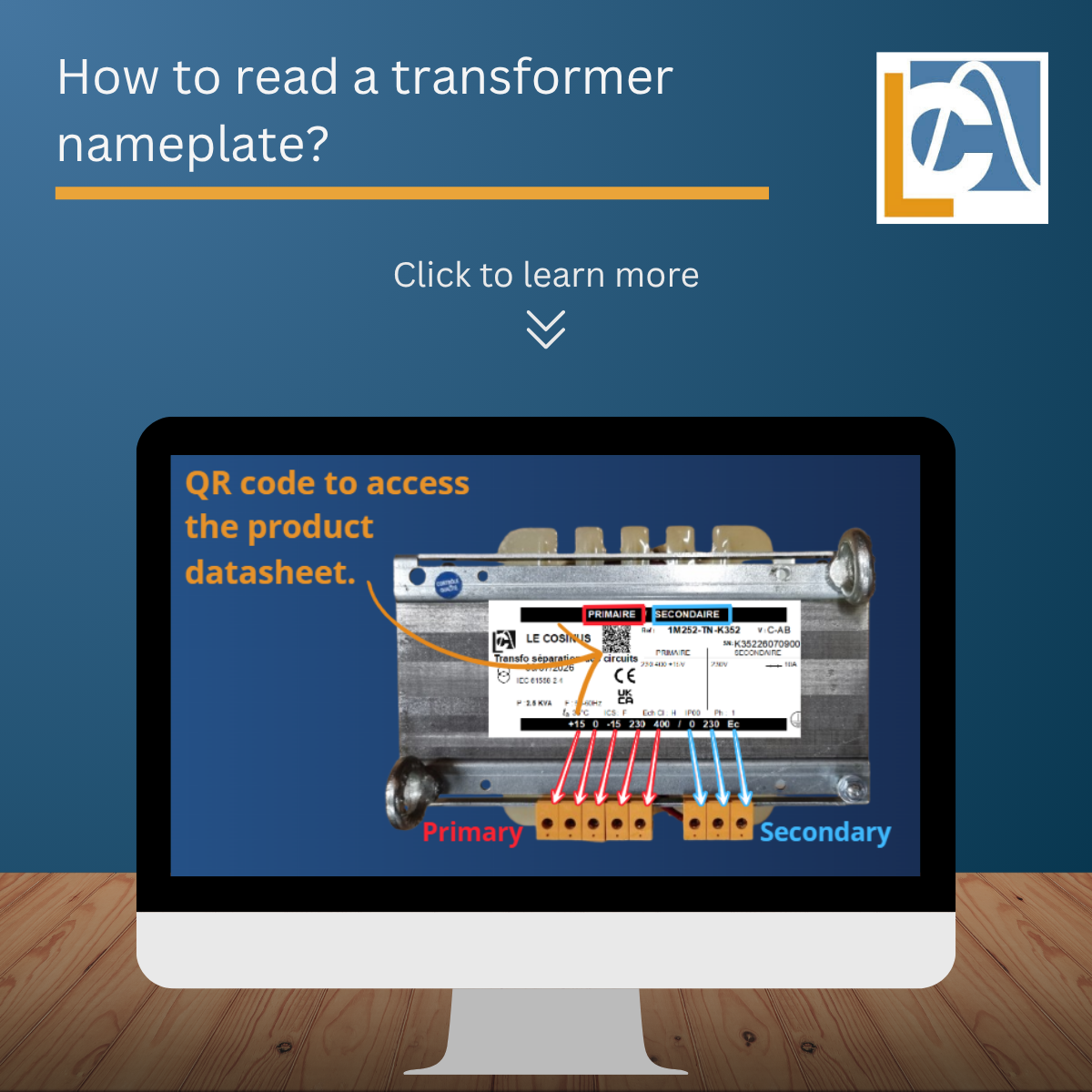
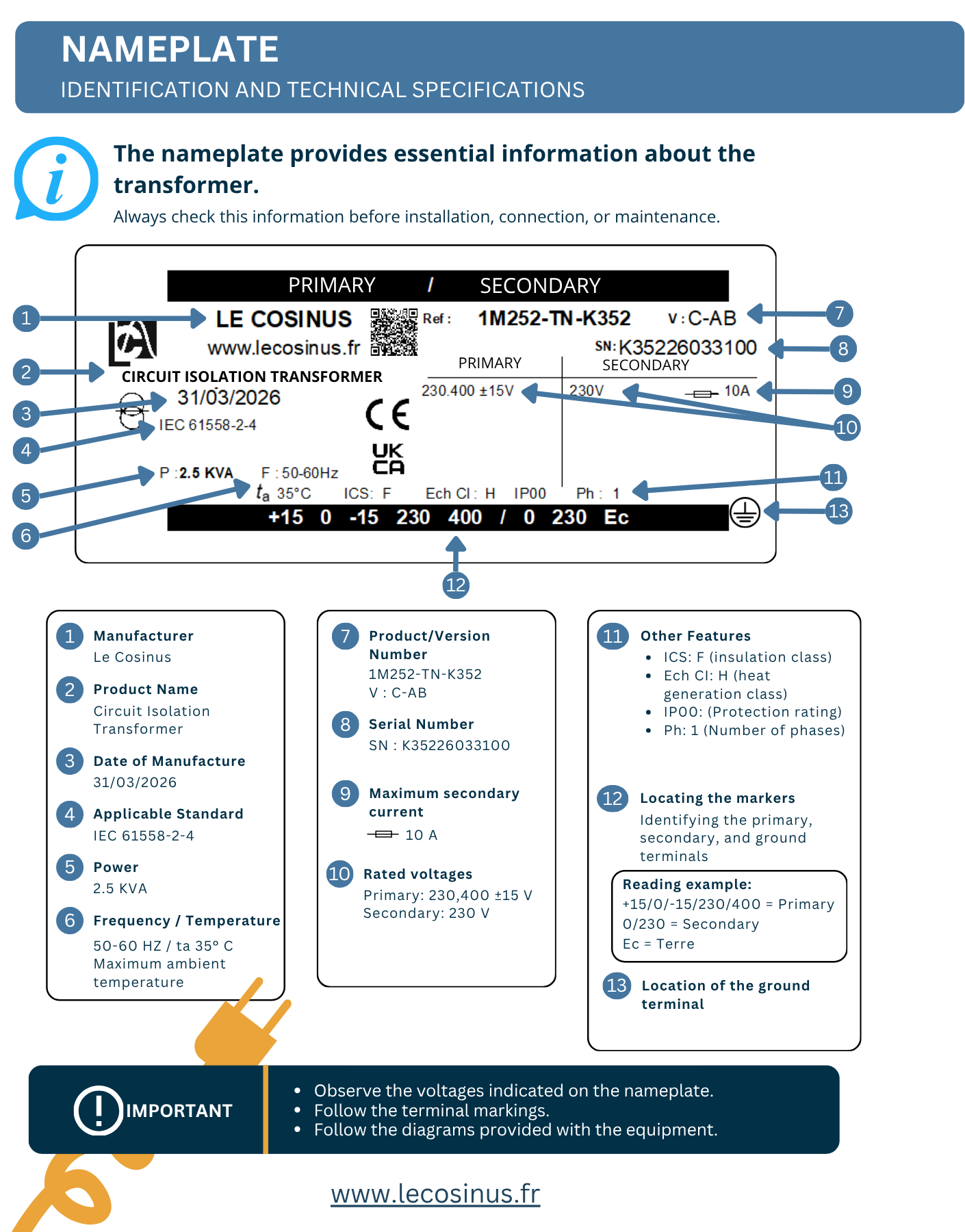
Let’s take the 1M252-TN-K352 transformer as an example.
Comprendre la plaque signalétique et le branchement d’un transformateur
The nameplate provides the main characteristics of the transformer. It includes, in particular:
The rated power (kVA);
The primary and secondary voltages;
The operating frequency;
The recommended fuse rating;
The voltage adjustment taps;
The manufacturing and insulation standards;
Traceability information (reference, serial number, version, and manufacturer).
Beyond its identification purpose, the nameplate serves as a practical guide to ensure a compliant and safe connection of the transformer.
Identifying the Connection Terminals
The diagram shown on the nameplate indicates the arrangement of the primary and secondary terminals.
On the 1M252-TN-K352 transformer, the primary winding provides two supply voltages, 230 V and 400 V, each equipped with ±15 V adjustment taps to compensate for variations in the mains voltage.
The primary terminals are as follows:
±15V
0
-15 V
230 V
400 V
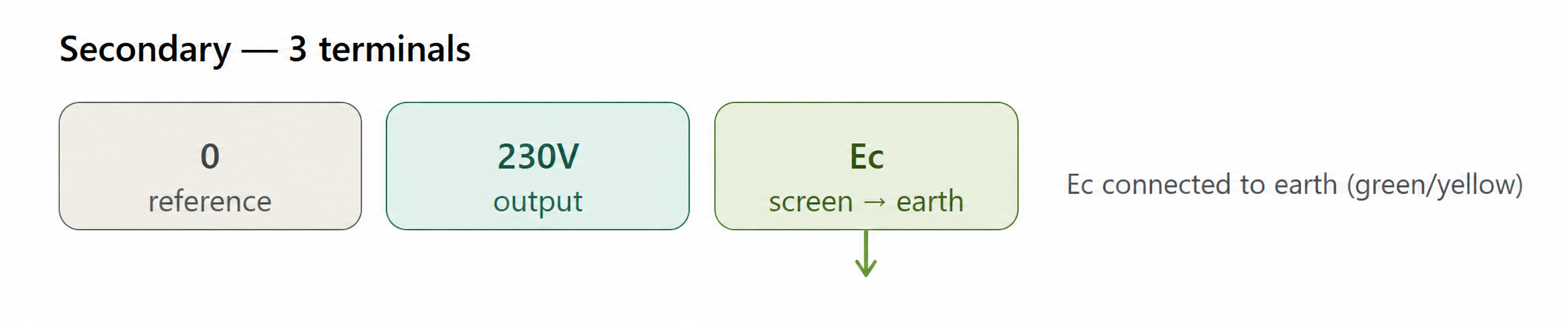
The secondary winding has three terminals:
0
230 V
Electrostatic shield (Ec)
The connection must always be carried out according to the order shown on the nameplate.
(The terminal order indicated on the label corresponds exactly to the physical terminal block arrangement).
230 V Primary Connection
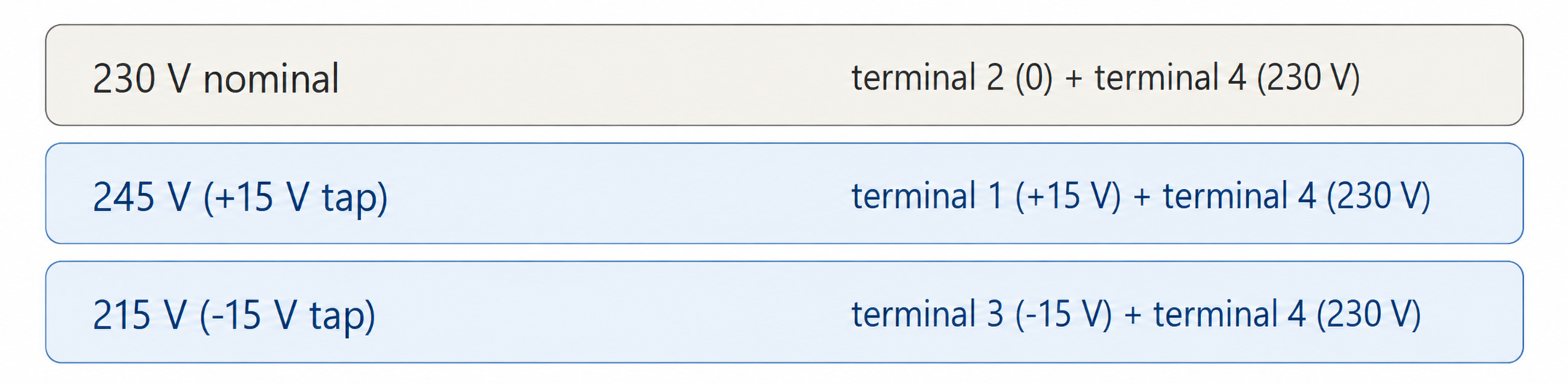
To supply the transformer with a 230 V, input voltage, the connection is made between the 0 V and 230 V terminals.
The adjustment taps allow the transformer to be adapted to variations in the supply voltage:
For a 245 V supply (+15 V), connect the +15 V and 230 V terminals;
For a 215 V supply (-15 V), connect the -15 V and 230 V terminals.
Connection Examples (Supply ➡️ Terminals)
400 V Primary Connection
The same principle applies when the transformer is supplied with a 400 V input voltage.
The nominal connection is made between the 0 V and 400 V terminals.
In the event of a variation in the supply voltage:
For a 415 V supply (+15 V), connect the +15 V and 400 V terminals;
For a 385 V supply (-15 V), connect the -15 V and 400 V terminals.
Connection Examples (Supply ➡️ Terminals)
Secondary Connection
The secondary winding provides a single 230 V output voltage.
The connection is made between the 0 V and 230 V terminals.
The third terminal corresponds to the l’electrostatic shield(Ec).
It is generally connected to earth (green/yellow conductor) to provide shielding between the primary and secondary windings and to discharge electrical disturbances to ground.
This connection also contributes to improving the installation’s electromagnetic compatibility (EMC) by reducing the transmission of electrical noise and interference.
Quickly Access Information Using the QR Code
Le Cosinus transformers can be equipped with a QR code providing direct access to their online product page.
By scanning the QR code with a smartphone, you can instantly access:
The transformer's technical specifications;
Available power ratings and options;
Dimensions and installation data;
The downloadable technical datasheet;
The option to request a quotation or additional information.
This solution allows essential transformer information to be accessed quickly directly from the field. It simplifies installation, maintenance, and troubleshooting operations.
Recommendation
The connection of a transformer must be carried out with the power supply switched off by a qualified person.
Before any intervention, it is essential to check the characteristics of the electrical network, comply with the information provided on the transformer nameplate, and follow the applicable electrical standards to ensure the safety of both personnel and equipment.
Une machine éloignée du tableau électrique, ou qui ne fonctionne pas avec la tension disponible sur le site : dans ces situations, plusieurs solutions existent, et l’autotransformateur en fait partie.…
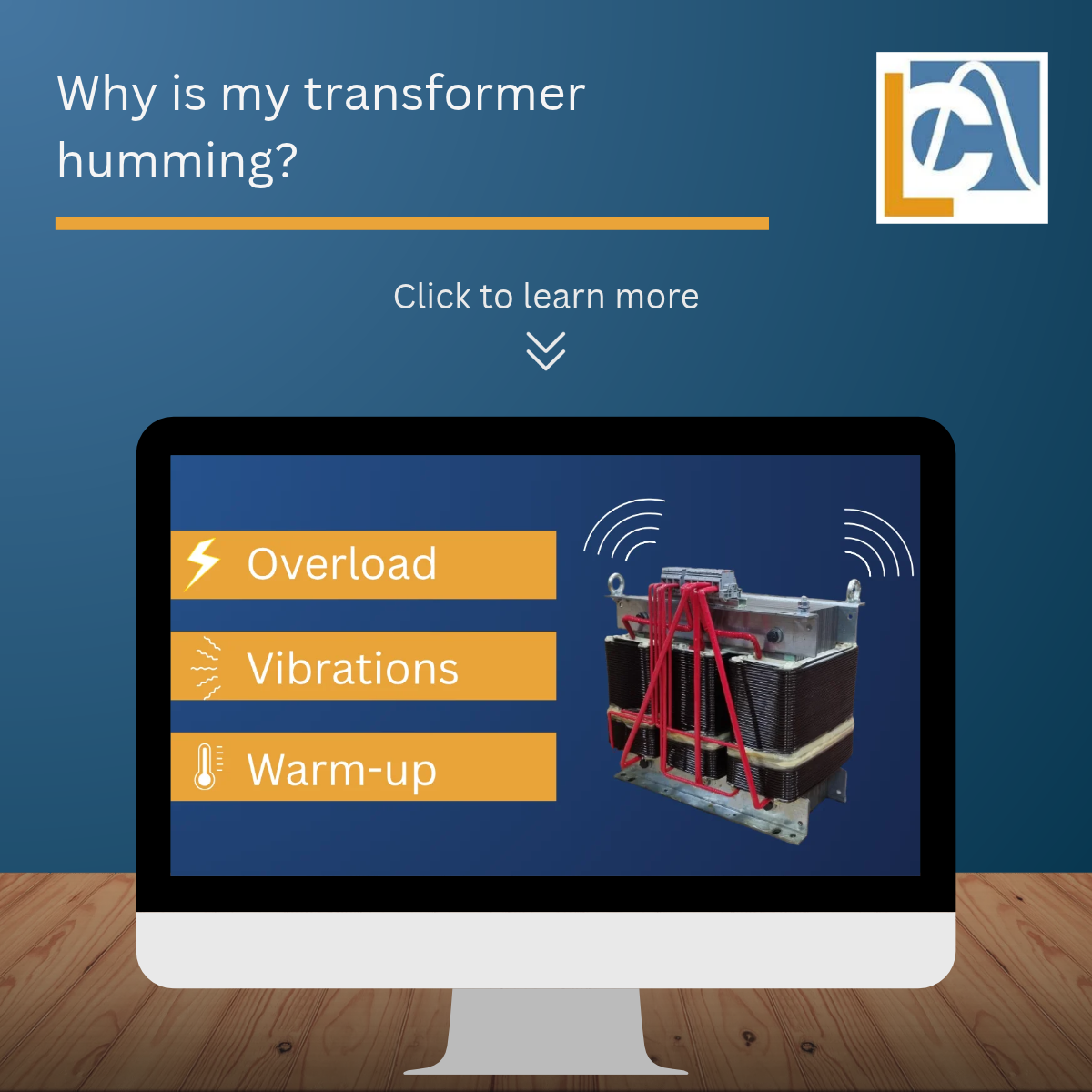
A transformer that hums isn't necessarily defective. An electrical transformer naturally produces a slight hum when it's operating. The laminations in the magnetic circuit expand and contract very slightly…
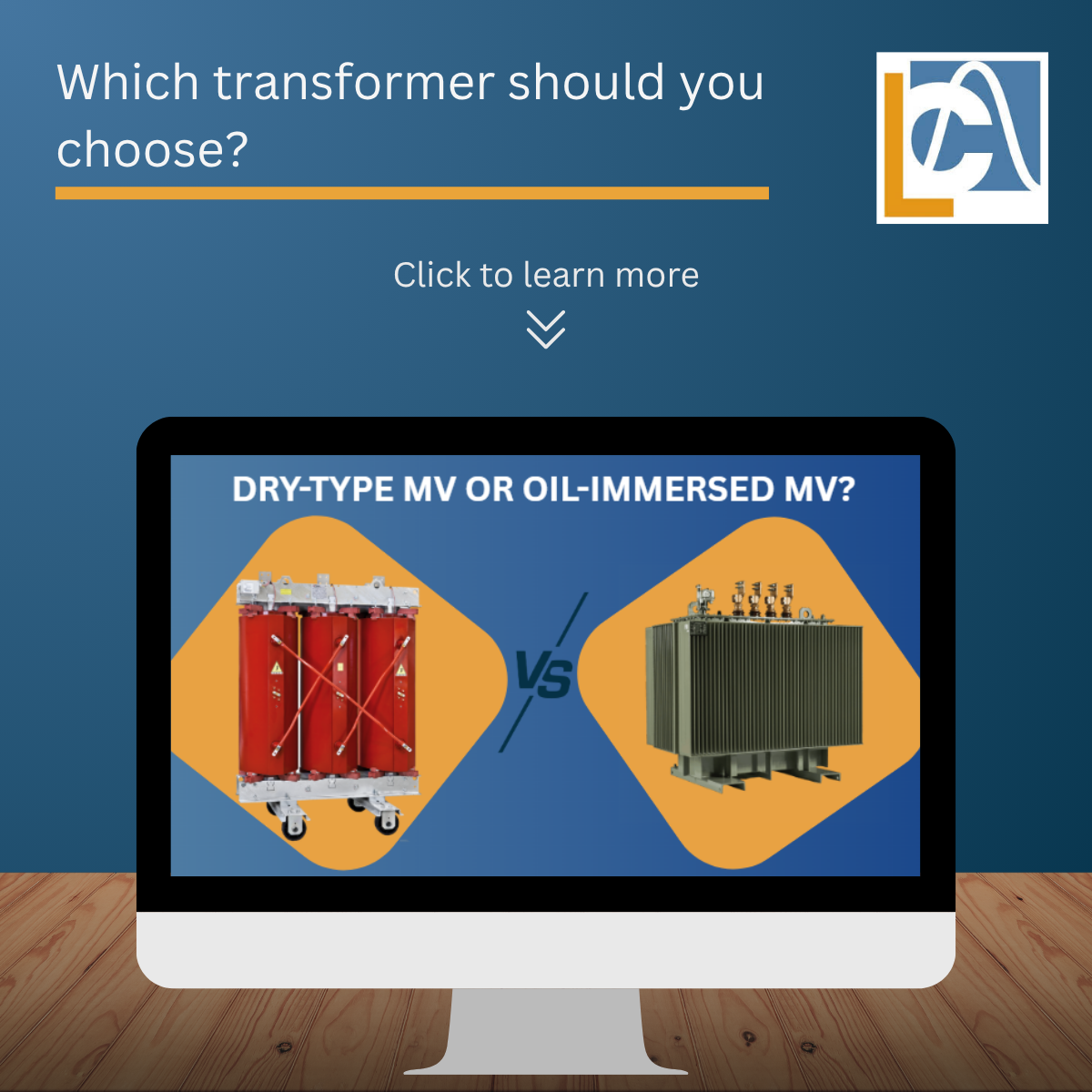
When equipping an HV/MV substation, the choice of transformer is not simply a matter of power rating. The installation environment, safety constraints, maintenance requirements…