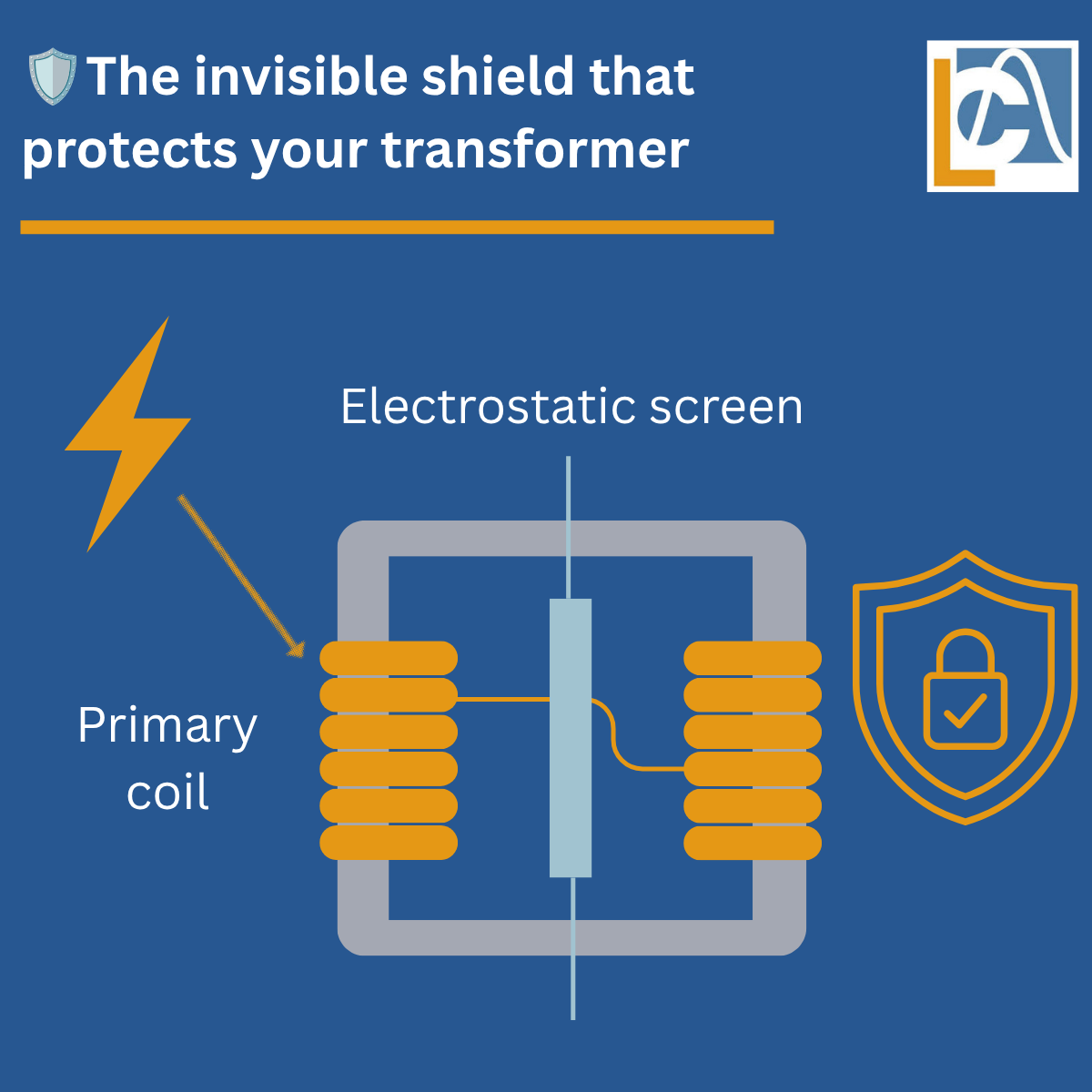
Unlike the invention of the transformer itself, which is often associated with pioneers such as Faraday or Zipernowsky, Bláthy and Déri, the electrostatic screen is not the work of a single inventor. Rather, it is a gradual improvement, born with the appearance of electronics in power grids.
Why was an electrostatic screen introduced?
Originally, the objective was simple: to limit the capacitive coupling between primary and secondary schools. This coupling, inherent to transformers, allowed certain electrical interference to pass through the device and reach the equipment being powered.
The addition of a screen, connected to the ground, made it possible to meet two essential needs:
Reduce interference and electrical noise
High-frequency, transient, common-mode noise, network interference passed from one winding to another by capacitive effect. The screen acts as a "shield": it captures these disturbances and drifts them towards the earth, leaving the secondary much cleaner.
Strengthen security
If there is an insulation fault between the two windings, the display can divert the leakage currents to ground. This provides an extra level of protection for the devices... and for users.
And today, what is it for?
L’écran électrostatique reste largement utilisé, notamment dans les transformateurs d’isolement ou dans les applications sensibles où la qualité du signal électrique est indispensable.
Current roles:
Limiting noise and electromagnetic disturbances (EMI) Essential for medical equipment, computer systems, measurement laboratories and PLC-controlled machines.
Improve protection against electric shock The screen reinforces galvanic isolation and reduces the risks associated with a possible insulation defect.
Protecting the electrical environment from non-linear loads For example, variable speed drives, which are very common in industry, generate a lot of interference generally called harmonics.
Securing solar invertersIn photovoltaics, it helps filter transient surges coming from the grid or those generated by the inverter itself.
In short: An electrostatic shield is a conductive strip, usually made of copper or aluminum, placed between the primary and secondary of a transformer and connected to the ground. It is used to block interference, clean the power supply, and improve the safety of the assembly.
Une machine éloignée du tableau électrique, ou qui ne fonctionne pas avec la tension disponible sur le site : dans ces situations, plusieurs solutions existent, et l’autotransformateur en fait partie.…
A transformer that hums isn't necessarily defective. An electrical transformer naturally produces a slight hum when it's operating. The laminations in the magnetic circuit expand and contract very slightly…
Connecting a transformer is not just about connecting conductors. To ensure a reliable, high-performance and safe installation, it is essential to know how to correctly interpret the nameplate.…